New Indicators of Resilience added to the Safe Cities Index 2019. Tokyo, Singapore and Osaka ranked top 3.
You are here
出版物 & 研究
出版物 & 研究
我們為研究人員、災難管理人員、醫護人員及學生,提供一個專業交流、合作及政策討論的平台

出版物 & 研究
香港賽馬會災難防護應變教研中心的出版物涵蓋了教研中心跟合作夥伴、顯赫學術機構的研究項目,以及有關災難防護和應變的其他研究與開發。
指引列出了教研中心特別揀選的災難管理技術資訊、操作指引和有用工具。
博客提供了一個平台,讓持份者能分享與災難有關的最新動態、意見及經驗分享。
博客文章由作者以個人身份或代表所屬單位撰寫。內容表達的觀點、思維及意見純屬作者個人想法,並不代表香港賽馬會災難防護應變教研中心的立場。
公眾可在尊重知識產權情況下,使用所有資料,並必須適當引述出處。
2019
29/09/2019
New Indicators of Resilience added to the Safe Cities Index 2019. Tokyo, Singapore and Osaka ranked top 3.
11/09/2019
The Global Assessment Report on Disaster Risk Reduction (GAR) is a biennial global assessment of disaster risk reduction highlighting latest updates, emerging trends, disaster patterns and progress in reducing risk. It aims to focus international attention on the issue of disaster risk and encourage political and economic support for disaster risk reduction. The GAR is produced by the UN Office for Disaster Risk Reduction in collaboration and consultation with a wide range of stakeholders, with thinkers, practitioners, experts and innovators to investigate the state of risk across the globe.
The Global Assessment Report on Disaster Risk Reduction (GAR) is a biennial global assessment of disaster risk reduction highlighting latest updates, emerging trends, disaster patterns and progress in reducing risk. It aims to focus international attention on the issue of disaster risk and encourage political and economic support for disaster risk reduction. The GAR is produced by the UN Office for Disaster Risk Reduction in collaboration and consultation with a wide range of stakeholders, with thinkers, practitioners, experts and innovators to investigate the state of risk across the globe.
The GAR19 (the GAR 2019) moves beyond disaster risk to consider the pluralistic nature of risk: in multiple dimensions, at multiple scales and with multiple impacts. It provides an update on how we – as governments, as communities and individuals – understand our relationship with risk and its reduction.
The Full Report and a guided tour are available at the GAR19 Website: https://gar.unisdr.org/report-2019
Want some quick take-home messages from the detailed full report? The GAR19 Distilled collates 10 take-home observations from GAR19. Each observation is linked to the relevant section in the GAR19 main report. The link to GAR19 Distilled: https://gar.unisdr.org/sites/default/files/gar19distilled.pdf
The GAR19 Distilled offers 10 take-home messages from the full report.
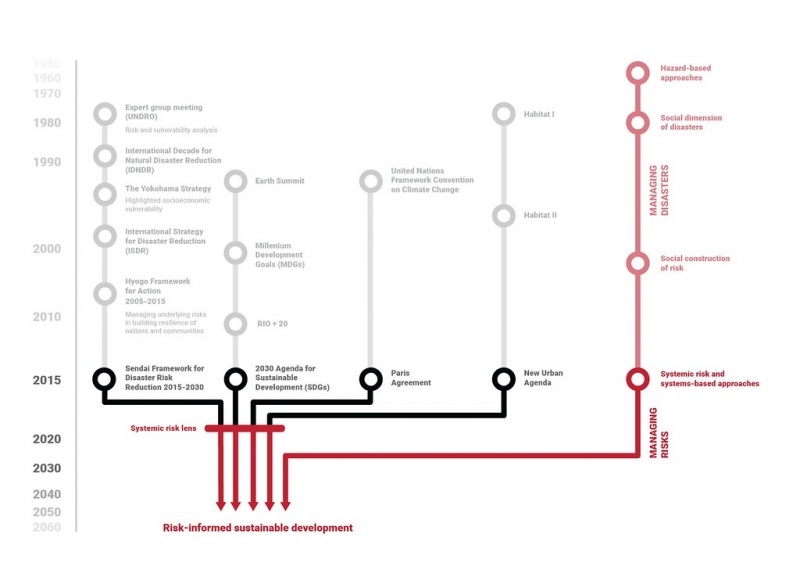
An illustration showing evolution of the global policy agenda for disaster risk reduction: A journey through time and space.
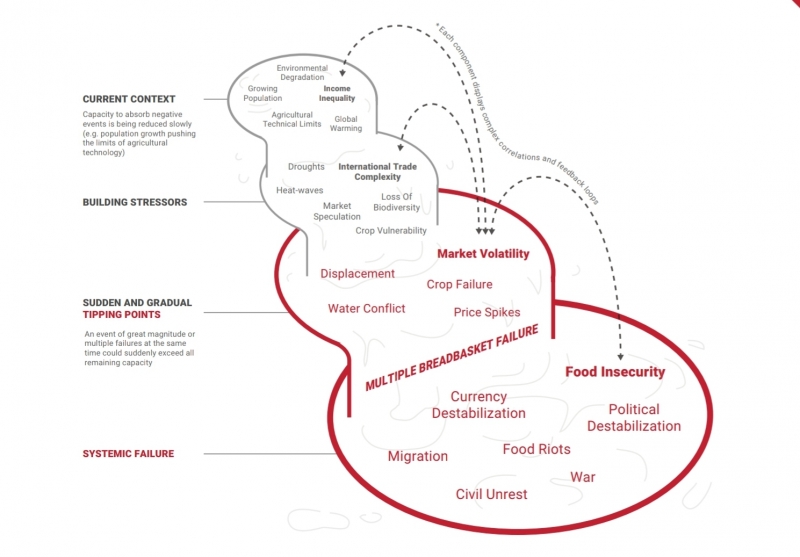
An illustration showing how systemic risks are assessed and analysed: Mapping the topology of risk through time.
by HKJCDPRI

14/06/2019
A megacity facing high risks from natural hazards
Megacities can be seriously susceptible to various natural hazards potentially posing negative impacts on human health, economy and sustainability. With the global population living in urban cities projected to increase to 66% by 2050, building disaster resilient in big cities has become a global focus in the last decade.
A megacity facing high risks from natural hazards
Megacities can be seriously susceptible to various natural hazards potentially posing negative impacts on human health, economy and sustainability. With the global population living in urban cities projected to increase to 66% by 2050, building disaster resilient in big cities has become a global focus in the last decade.
Hong Kong is considered a megacity and faces high risks from natural hazards such as heavy rainfall, storm surges, and tropical cyclones. These events often trigger floods and landslides and could cause critical damage to the city. As these consequences are still rare, the researchers believed that disaster preparedness and risk recognition might be underestimated in Hong Kong. Nevertheless in the wake of climate change, Hong Kong may face unpredictable future climate.
The team of researchers used Hong Kong as a case study to demonstrate how to analyse a megacity’s disaster resilience and to show how the findings could be interpreted into practice.
What did the research involve?
This study used the Sendai Framework Local Urban Indicators (LUI) Tools developed by the United Nation Office for Disaster Risk Reduction for the evaluation. LUI helps local stakeholders to evaluate a city’s disaster resilience performance and to help them implement appropriate policies. 31 LUI indicators were selected and categorised into 10 essential components from the ‘Ten Essentials for Making Cities Resilient’ framework. Answers to the indicator questions highlighted levels of disaster resilience and gaps.
Findings and interpretations
Hong Kong’s integrated disaster resilience scored 4.2 out of 5, indicating a satisfactory performance of the integrated performance of disaster resilience.
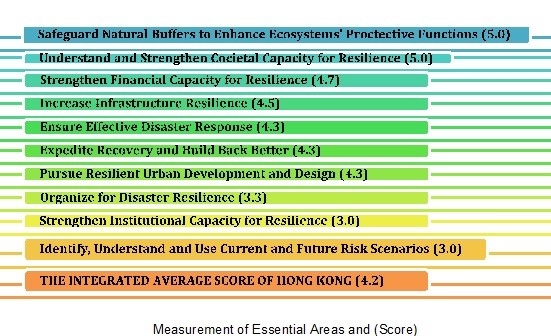
These findings indicated that Hong Kong was largely disaster resilient in the following context:
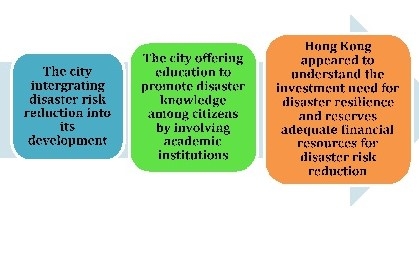
However, this study also identified some areas for improvement. Hong Kong may need to improve institutional organisation for disaster governance between the government and society especially in regard to disaster risk identification and information sharing systems. Furthermore, Hong Kong’s disaster management system tends to focus on immediate emergency response and building physical resilience, however the city needs to develop a more comprehensive and long-term DRR strategy and vision to improve disaster resilience.
Conclusion
Building disaster resilient cities involves large amount of effort in understanding, assessing, and managing disaster risks. This type of investigation can help expand our knowledge of disaster resilience through providing in-depth analysis, by directing further studies and prompting city planners and policy makers to consider more appropriate sustainable development for cities. Finally, there is a pressing need in raising the disaster risk preparedness of Hong Kong’s general public, and a knitted society to facilitate roles in the recovery process.
This article is summarised from: Timothy Sim & Dongming Wang & Ziqiang Han, 2018. "Assessing the Disaster Resilience of Megacities: The Case of Hong Kong," Sustainability, MDPI, Open Access Journal, vol. 10(4), pages 1-16, April.
https://www.mdpi.com/2071-1050/10/4/1137/pdf
22/05/2019
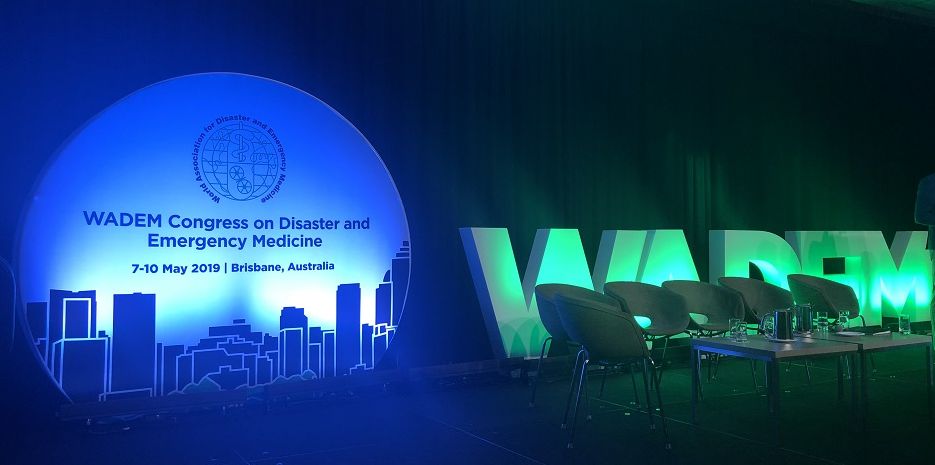
Two representatives of the Hong Kong Jockey Club Disaster Preparedness and Response Institute (HKJCDPRI) participated in the World Association for Disaster and Emergency Medicine (WADEM) Congress held on 7 – 10 May 2019. The WADEM Congress is a biennial international event which provides an interactive and stimulating environment for participants to share research and findings, exchange ideas and best practices and network with peers.
Two representatives of the Hong Kong Jockey Club Disaster Preparedness and Response Institute (HKJCDPRI) participated in the World Association for Disaster and Emergency Medicine (WADEM) Congress held on 7 – 10 May 2019. The WADEM Congress is a biennial international event which provides an interactive and stimulating environment for participants to share research and findings, exchange ideas and best practices and network with peers.
With a theme of “The Future”, the Congress 2019 held in Brisbane, Australia included over 30 tracks with high profile speakers, as well as a wide range of interactive sessions for participants to share experience and knowledge gained from their work. During the congress, the HKJCDPRI representatives shared two projects with congress participants at the poster presentation and oral presentation sessions.
During the poster presentation session, Ms Angel Ng, Senior Manager of the HKJCDPRI, presented a study entitled “Mental Health Impacts on People Living in Subdivided Flats in Hong Kong”. In collaboration with the Hong Kong Sheng Kung Hui (HKSKH) Lady MacLehose Centre, the study was a mixed quantitative and qualitative study to investigate the impact of poor living conditions such as fire risks, environmental health risks and other chronic health issues in subdivided flats on the residents.
During the oral presentation session, Ms Tiffany Yeung, Manager (Professional Development) of the HKJCDPRI, shared with the audience a survey conducted by the HKJCDPRI entitled “Typhoon Preparedness Measures of the Hong Kong Public for Typhoon Mangkhut” and its associated survey findings. The aim of the study was to understand the general Hong Kong public’s awareness and views on the super typhoon that slammed Hong Kong in September 2018 and precautionary measures carried out. The public’s information seeking behaviours and self-reported confidence in their knowledge on typhoon preparedness was also investigated. More details of the study and the analysis can be seen in another report (click this link).
Since 2015, the HKJCDPRI has actively participated in the WADEM Congress by sharing of experience and exchange of ideas with the congress participants. The knowledge and insights gained for the HKJCDPRI’s learning for continuous improvement of work is invaluable.
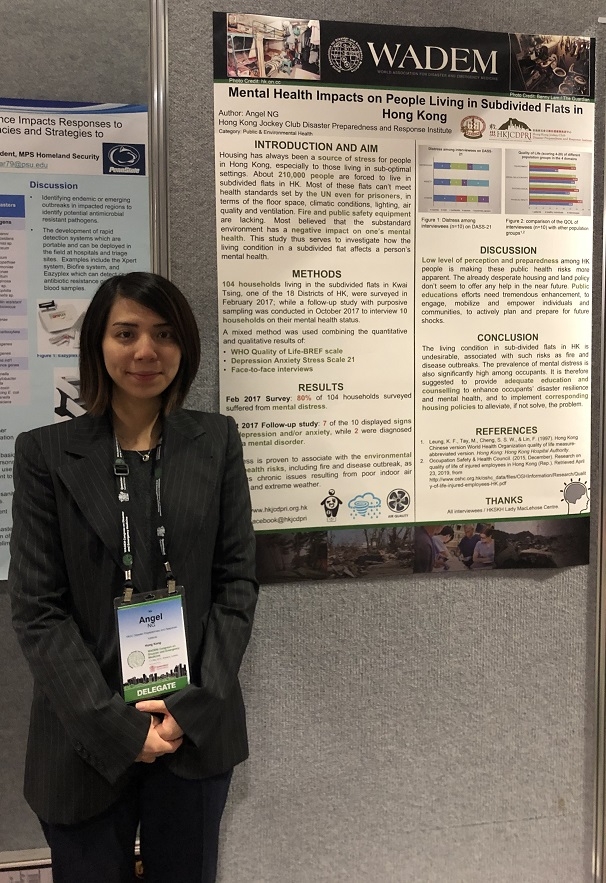
The HKJCDPRI staff, Ms Angel Ng (Senior Manager), presented on “Mental Health Impacts on People Living in Subdivided Flats in Hong Kong”.
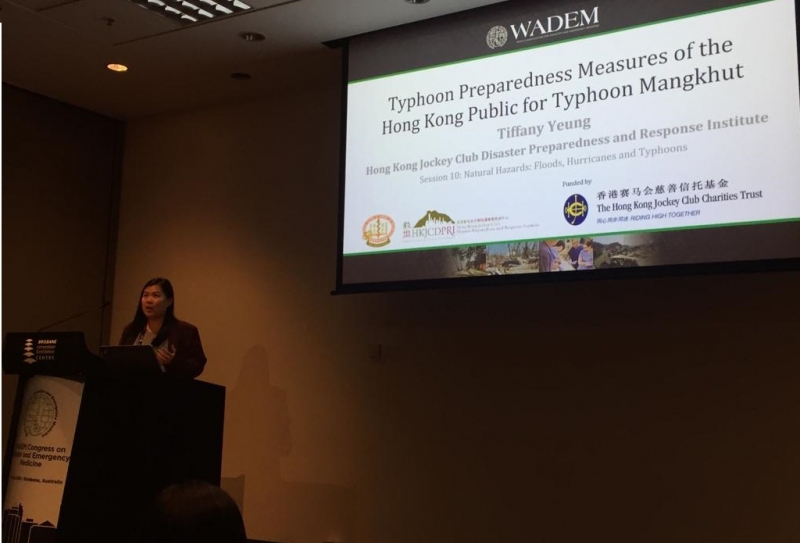
The HKJCDPRI staff, Ms Tiffany Yeung (Manager (Professional Development)), presented on “Typhoon Preparedness Measures of the Hong Kong Public for Typhoon Mangkhut”