Two representatives of the Hong Kong Jockey Club Disaster Preparedness and Response Institute (HKJCDPRI) participated in the World Association for Disaster and Emergency Medicine (WADEM) Congress held on 7 – 10 May 2019. The WADEM Congress is a biennial international event which provides an interactive and stimulating environment for participants to share research and findings, exchange ideas and best practices and network with peers.
You are here
出版物 & 研究
出版物 & 研究
我們為研究人員、災難管理人員、醫護人員及學生,提供一個專業交流、合作及政策討論的平台

出版物 & 研究
香港賽馬會災難防護應變教研中心的出版物涵蓋了教研中心跟合作夥伴、顯赫學術機構的研究項目,以及有關災難防護和應變的其他研究與開發。
指引列出了教研中心特別揀選的災難管理技術資訊、操作指引和有用工具。
博客提供了一個平台,讓持份者能分享與災難有關的最新動態、意見及經驗分享。
博客文章由作者以個人身份或代表所屬單位撰寫。內容表達的觀點、思維及意見純屬作者個人想法,並不代表香港賽馬會災難防護應變教研中心的立場。
公眾可在尊重知識產權情況下,使用所有資料,並必須適當引述出處。
2019
22/05/2019
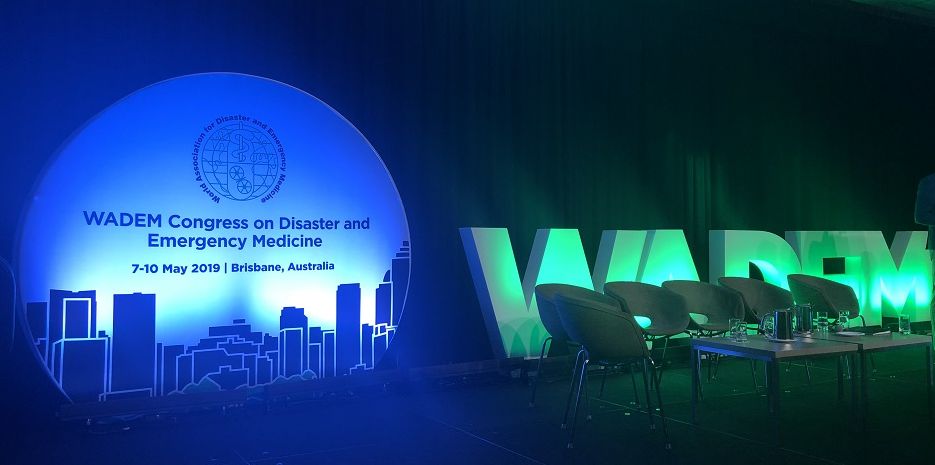
Two representatives of the Hong Kong Jockey Club Disaster Preparedness and Response Institute (HKJCDPRI) participated in the World Association for Disaster and Emergency Medicine (WADEM) Congress held on 7 – 10 May 2019. The WADEM Congress is a biennial international event which provides an interactive and stimulating environment for participants to share research and findings, exchange ideas and best practices and network with peers.
With a theme of “The Future”, the Congress 2019 held in Brisbane, Australia included over 30 tracks with high profile speakers, as well as a wide range of interactive sessions for participants to share experience and knowledge gained from their work. During the congress, the HKJCDPRI representatives shared two projects with congress participants at the poster presentation and oral presentation sessions.
During the poster presentation session, Ms Angel Ng, Senior Manager of the HKJCDPRI, presented a study entitled “Mental Health Impacts on People Living in Subdivided Flats in Hong Kong”. In collaboration with the Hong Kong Sheng Kung Hui (HKSKH) Lady MacLehose Centre, the study was a mixed quantitative and qualitative study to investigate the impact of poor living conditions such as fire risks, environmental health risks and other chronic health issues in subdivided flats on the residents.
During the oral presentation session, Ms Tiffany Yeung, Manager (Professional Development) of the HKJCDPRI, shared with the audience a survey conducted by the HKJCDPRI entitled “Typhoon Preparedness Measures of the Hong Kong Public for Typhoon Mangkhut” and its associated survey findings. The aim of the study was to understand the general Hong Kong public’s awareness and views on the super typhoon that slammed Hong Kong in September 2018 and precautionary measures carried out. The public’s information seeking behaviours and self-reported confidence in their knowledge on typhoon preparedness was also investigated. More details of the study and the analysis can be seen in another report (click this link).
Since 2015, the HKJCDPRI has actively participated in the WADEM Congress by sharing of experience and exchange of ideas with the congress participants. The knowledge and insights gained for the HKJCDPRI’s learning for continuous improvement of work is invaluable.
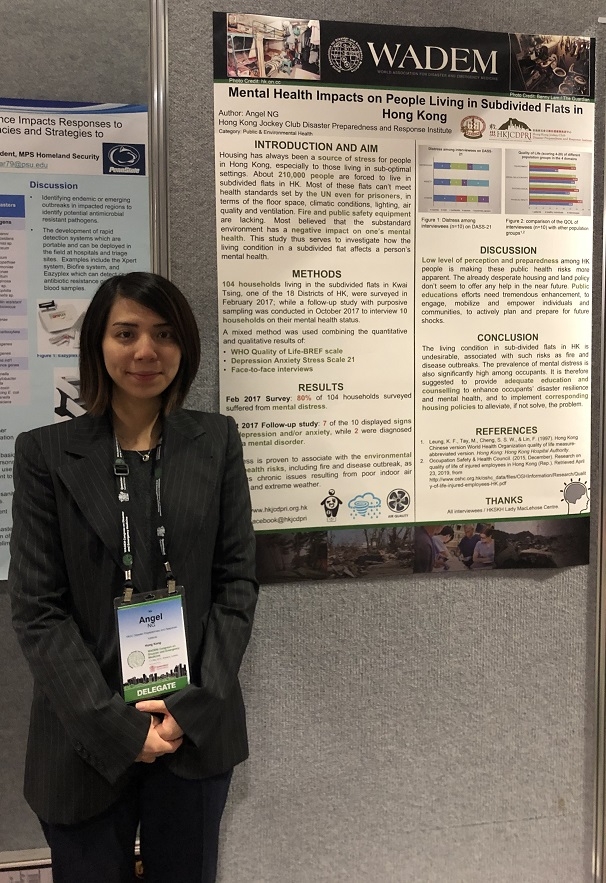
The HKJCDPRI staff, Ms Angel Ng (Senior Manager), presented on “Mental Health Impacts on People Living in Subdivided Flats in Hong Kong”.
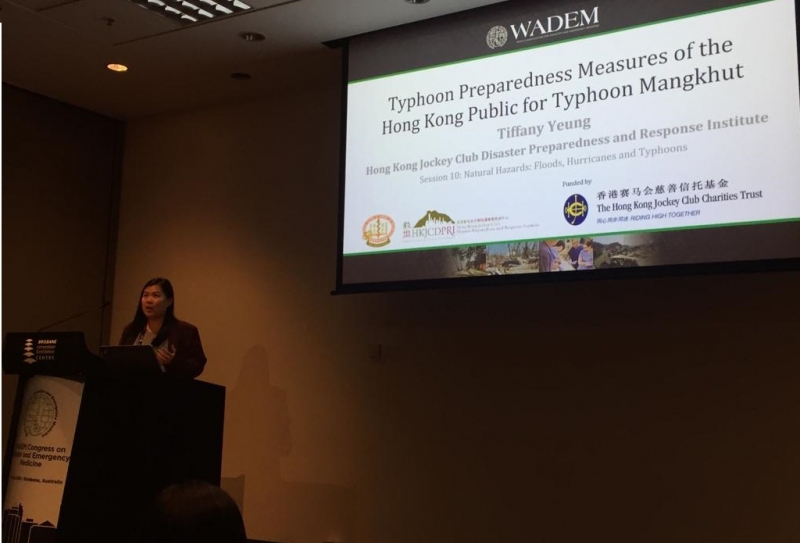
The HKJCDPRI staff, Ms Tiffany Yeung (Manager (Professional Development)), presented on “Typhoon Preparedness Measures of the Hong Kong Public for Typhoon Mangkhut”
2018
22/11/2018
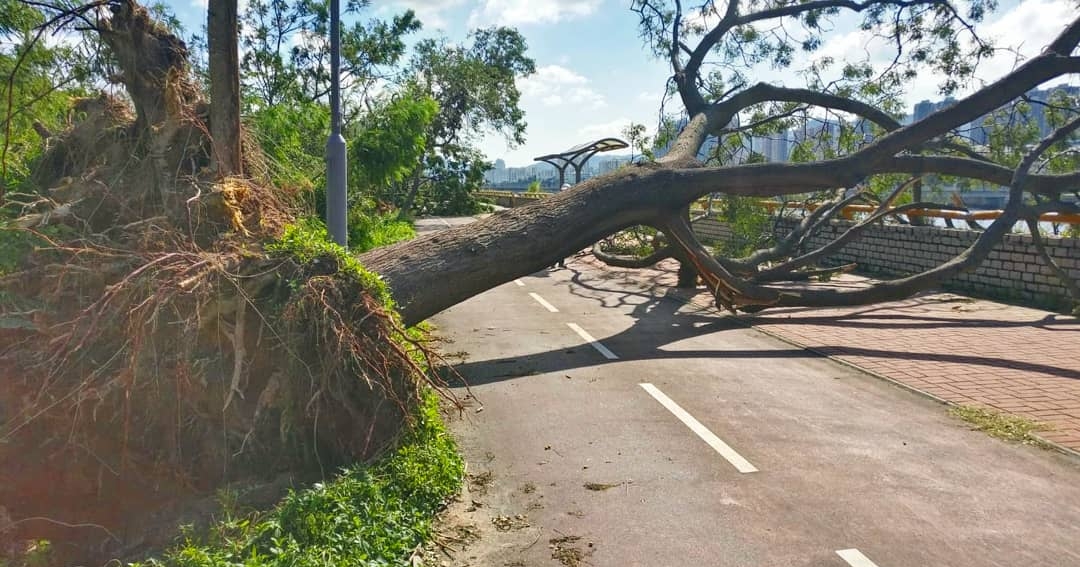
(Please click here for the Chinese version)(Please click here for the Chinese version)(Hong Kong, 6 Nov 2018) Hong Kong is still reeling from the impacts of super Typhoon Mangkhut after it devastated the city more than a month ago. The Hong Kong Jockey Club Disaster Preparedness and Response Institute (HKJCDPRI) commissioned the Public Opinion Programme of the University of Hong Kong to conduct a survey to gauge the public awareness and views of typhoon preparedness for Mangkhut. Findings of the survey were released today.
The survey showed that almost half (45%) of the interviewees taped windows to reduce damage and injury by broken glass which is the main precautionary measure taken by the interviewees when Mangkhut hit the city.
(Please click here for the Chinese version)(Please click here for the Chinese version)(Hong Kong, 6 Nov 2018) Hong Kong is still reeling from the impacts of super Typhoon Mangkhut after it devastated the city more than a month ago. The Hong Kong Jockey Club Disaster Preparedness and Response Institute (HKJCDPRI) commissioned the Public Opinion Programme of the University of Hong Kong to conduct a survey to gauge the public awareness and views of typhoon preparedness for Mangkhut. Findings of the survey were released today.
The survey showed that almost half (45%) of the interviewees taped windows to reduce damage and injury by broken glass which is the main precautionary measure taken by the interviewees when Mangkhut hit the city.

30/04/2018
Every summer, Hong Kong is faced with multiple typhoons and excessive rainfall, consequently inducing landslides, increasing potential disaster threats. Prevention of landslides is the best way to combat such natural phenomenon.
Every summer, Hong Kong is faced with multiple typhoons and excessive rainfall, consequently inducing landslides, increasing potential disaster threats. Prevention of landslides is the best way to combat such natural phenomenon.
We have a piece of good news to share with you all! A research project jointly organized by Hong Kong Jockey Club Disaster Preparedness and Response Institute (HKJCDPRI), The Geotechnical Engineering Office (GEO) of the Civil Engineering and Development Department (CEDD) of the Government of the Hong Kong Special Administrative Region, and Hong Kong University of Science and Technology (HKUST) is currently underway to carry out a pilot test for a smart landslide barrier system. The impact switch uses a simple, energy-saving design. If successful, it will be one of the first successful applications to provide critical real-time detection of landslide impact and even serve as an early-warning system to downstream facilities.
In order to understand more about the upcoming research on a Smart Landslide Barrier system HKJCDPRI visited the large-scale flume model at the Hong Kong Kadoorie Centre on the 29 Sept 2017 to learn more about the research on interaction between landslides and barriers.
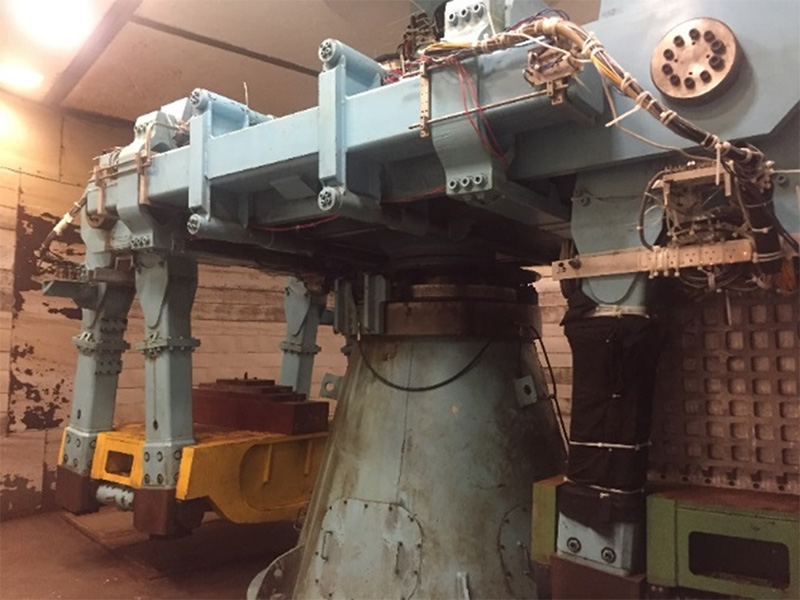
The geotechnical centrifuge at the HKUST Geotechnical Engineering Laboratory
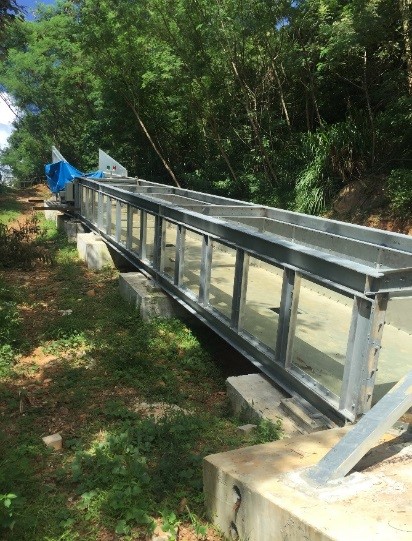
A 20-m-long flume model to study the fundamental interaction mechanisms between landslides and barriers at the Kadoorie Centre
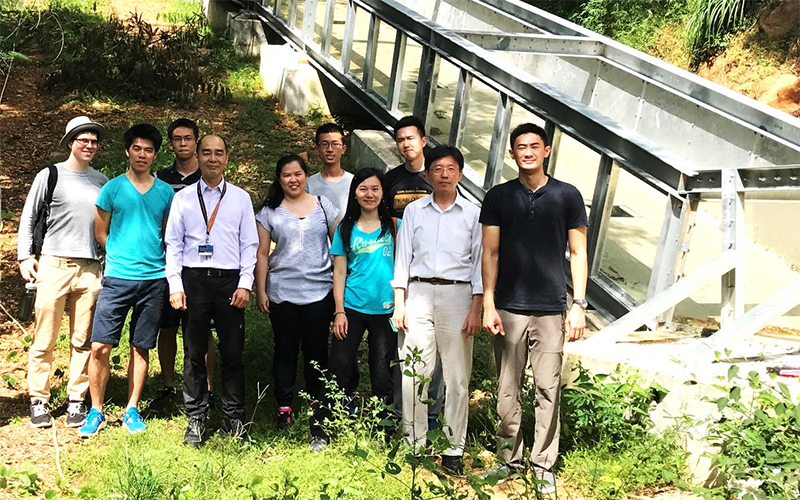
Visit to the HKUST large-scale debris flow flume facility between HKUST and the Hong Kong Jockey Club Disaster Preparedness and Response Institute
(from third to the left on the front row: Mr. Roger Cheung (previous Assistant Director of HKJCDPRI); Ms. Tiffany Yeung (Manager (Professional Development) of HKJCDPRI); Ms. Eva Lam (Director of HKJCDPRI); Dr. Chow Yu Fat (Executive Committee member of HKJCDPRI); Dr. Clarence Choi (Principal Investigator of the research)
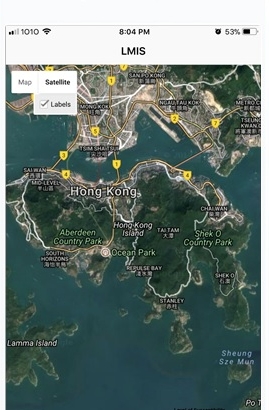
14/03/2018
The research entitled “Smart Landslide Information System” led by the research team of the Department of Civil and Engineering of the Hong Kong University of Science and Technology, in collaboration with the Hong Kong Jockey Club Disaster Preparedness and Response Institute was completed in November 2017.
A hilly terrain and seasonal torrential rainfalls present Hong Kong with the ideal conditions for landslides. With the advent of climate change, the number, scale, spatial extent, and frequency of landslides are expected to be unprecedented. With a comprehensive and world-leading slope safety system in place, there are always opportunities to examine ways to embrace technology and try to further enhance the management of landslide disasters to cope with the dynamic climate conditions that the world is facing.
The research entitled “Smart Landslide Information System” led by the research team of the Department of Civil and Engineering of the Hong Kong University of Science and Technology, in collaboration with the Hong Kong Jockey Club Disaster Preparedness and Response Institute was completed in November 2017.
A hilly terrain and seasonal torrential rainfalls present Hong Kong with the ideal conditions for landslides. With the advent of climate change, the number, scale, spatial extent, and frequency of landslides are expected to be unprecedented. With a comprehensive and world-leading slope safety system in place, there are always opportunities to examine ways to embrace technology and try to further enhance the management of landslide disasters to cope with the dynamic climate conditions that the world is facing.