In order to assist the Hong Kong Jockey Club Disaster Preparedness and Response Institute (HKJCDPRI) and other disaster management players in Hong Kong in identifying priority areas for research, training and partnerships, HKJCDPRI launched a Scoping Study titled “Disaster Preparedness in Hong Kong – A Scoping Study” to assess the current disaster preparedness situation in Hong Kong. The FXB Centre for Health and Human Rights at the Harvard T.H. Chan School of Public Health took the lead in coordination with the Harvard Humanitarian Initiative, the Emergency Medicine Unit at the University of Hong Kong, and the Collaborating Centre for Oxford University and CUHK for Disaster and Medical Humanitarian Response (CCOUC), in undertaking an extensive survey of a whole array of stakeholders in Hong Kong.
You are here
出版物 & 研究
出版物 & 研究
我們為研究人員、災難管理人員、醫護人員及學生,提供一個專業交流、合作及政策討論的平台

出版物 & 研究
香港賽馬會災難防護應變教研中心的出版物涵蓋了教研中心跟合作夥伴、顯赫學術機構的研究項目,以及有關災難防護和應變的其他研究與開發。
指引列出了教研中心特別揀選的災難管理技術資訊、操作指引和有用工具。
博客提供了一個平台,讓持份者能分享與災難有關的最新動態、意見及經驗分享。
博客文章由作者以個人身份或代表所屬單位撰寫。內容表達的觀點、思維及意見純屬作者個人想法,並不代表香港賽馬會災難防護應變教研中心的立場。
公眾可在尊重知識產權情況下,使用所有資料,並必須適當引述出處。
2016
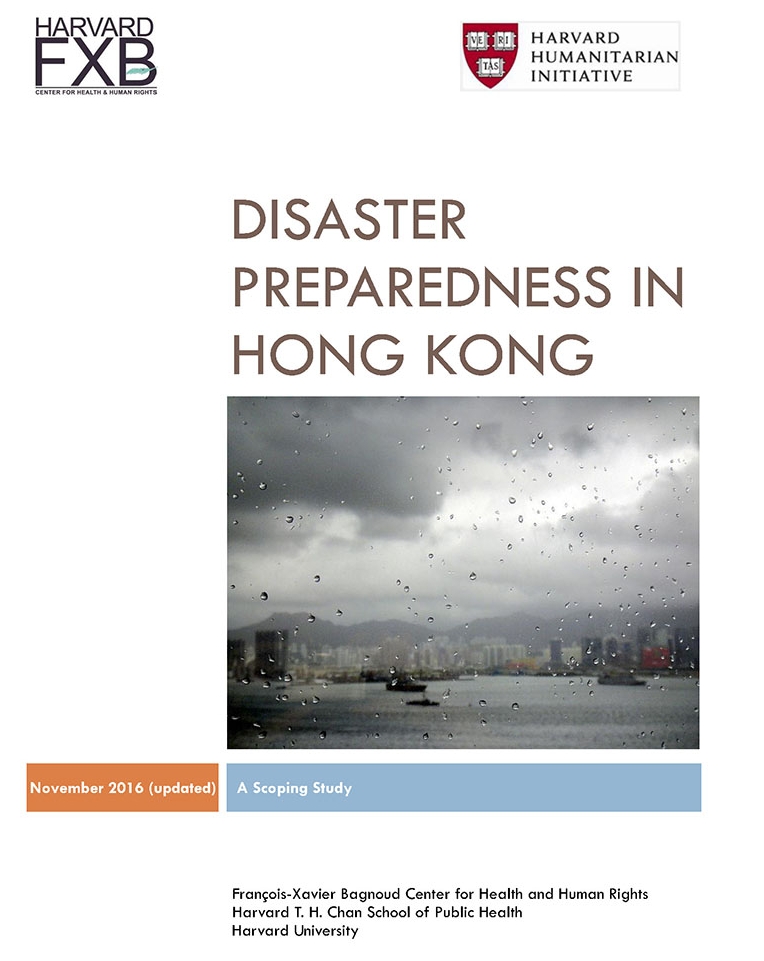
21/12/2016
In order to assist the Hong Kong Jockey Club Disaster Preparedness and Response Institute (HKJCDPRI) and other disaster management players in Hong Kong in identifying priority areas for research, training and partnerships, HKJCDPRI launched a Scoping Study titled “Disaster Preparedness in Hong Kong – A Scoping Study” to assess the current disaster preparedness situation in Hong Kong. The FXB Centre for Health and Human Rights at the Harvard T.H. Chan School of Public Health took the lead in coordination with the Harvard Humanitarian Initiative, the Emergency Medicine Unit at the University of Hong Kong, and the Collaborating Centre for Oxford University and CUHK for Disaster and Medical Humanitarian Response (CCOUC), in undertaking an extensive survey of a whole array of stakeholders in Hong Kong.
13/12/2016
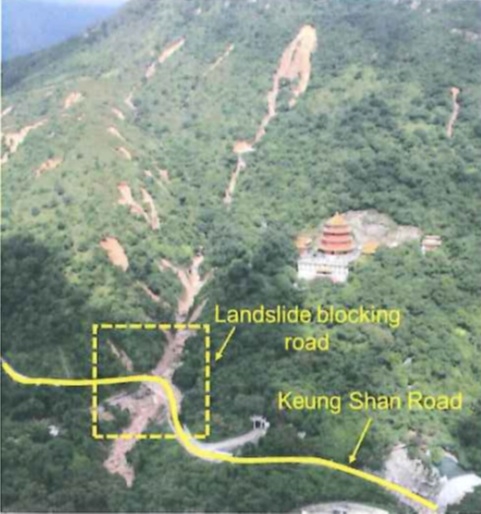
Aiming to provide accessible real-time landslide information to the public and leverage smart technology to ease and enhance landslide incident reporting in Hong Kong, The Hong Kong University of Science and Technology will develop a new smart Landslide Information System (LIS), in which will be supported by the HKJCDPRI Research Grant 2016. The project team consisted of three prominent professors including Prof Clarence Choi, Research Assistant Professor from the Department of Civil and Environmental Engineering (Principal Investigator), Prof Qian Zhang, Chair Professor from the Department of Computer Science and Engineering and Prof Charles Ng, Chair Professor from the Department of Civil and Environmental Engineering.
Aiming to provide accessible real-time landslide information to the public and leverage smart technology to ease and enhance landslide incident reporting in Hong Kong, The Hong Kong University of Science and Technology will develop a new smart Landslide Information System (LIS), in which will be supported by the HKJCDPRI Research Grant 2016. The project team consisted of three prominent professors including Prof Clarence Choi, Research Assistant Professor from the Department of Civil and Environmental Engineering (Principal Investigator), Prof Qian Zhang, Chair Professor from the Department of Computer Science and Engineering and Prof Charles Ng, Chair Professor from the Department of Civil and Environmental Engineering.
01/11/2016
Tai O is a low-lying area where serious flooding often occurs when typhoons and rainstorms strike. When Typhoon Hagupit hit Hong Kong in 2008, seawater intrusion significantly affected Tai O - water level rose in minutes and once became one-storey high, causing damage to furniture and properties.
Tai O is a low-lying area where serious flooding often occurs when typhoons and rainstorms strike. When Typhoon Hagupit hit Hong Kong in 2008, seawater intrusion significantly affected Tai O - water level rose in minutes and once became one-storey high, causing damage to furniture and properties.
After Typhoon Hguapit, the government was aware of the flood risks induced by storm surges and started improving disaster preparedness and resilience in Tai O. In terms of hardware, the Civil Engineering and Development Department constructed a breakwater in 2010 in hopes of tackling flooding problems as a result of high tides. As for software, the Islands District Office has specially formulated an “Emergency Response Plan” for Tai O residents in 2009. The plan was a joint effort of relevant government departments and community organizations in an attempt to help Tai O residents handle flooding crises when typhoons hit.
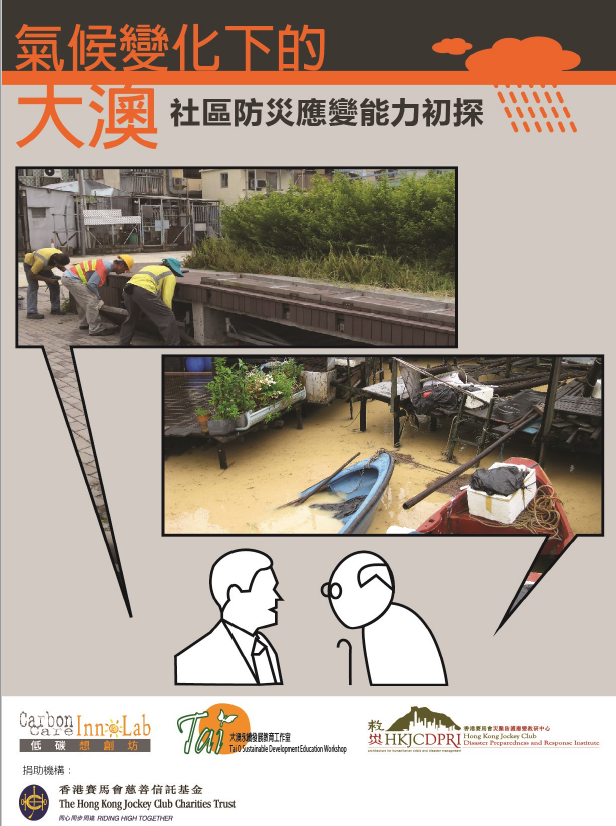
HKJCDPRI collaborated with two NGOs, namely Tai O Sustainable Development Education Workshop and CarbonCare InnoLab in 2016 to carry out a community research titled “Tai O Under Climate Change - A Preliminary Study on Disaster Preparedness and Response Capacity of the Community” in order to understand residents’ knowledge, level of participation and opinions on the “Emergency Response Plan” for Tai O.
The community research lasted from July to October. A total of 204 Tai O residents aged 15 or above were randomly selected to complete a structured questionnaire (Population size was 2,041) and 70 residents were invited to focus group interviews. Results showed that a majority of interviewees were unfamiliar with the plan, which has already been in effect for seven years since 2009; over half (53%) of them had no recollection of the plan.
Besides, 71% of the respondents have never received warning signals issued by the “Emergency Response Plan”; 73% have never seen the government organize emergency drills in Tai O. Meanwhile, less than 10% were able to accurately locate the two temporary shelters in Tai O. Other survey data also reflected that the Plan has failed to work effectively. Residents were only notified of warning signals through district organizations and village representatives and were worried that in case of serious flooding in the future, they may not be able to respond effectively.
Tai O is a high-risk community under climate change conditions. In view of this, the government worked out the first ever local response plan in Hong Kong which played an exemplary role in building disaster resilience in the community. HKJCDPRI hopes that relevant departments would continue to advance the system and take into consideration measures such as increasing residents’ engagement in flood drills, opening the two temporary shelters for visit, inviting telecommunications suppliers to support and strengthen notification network, setting up more bulletin boards on emergency escape plans and water marks, and so on.
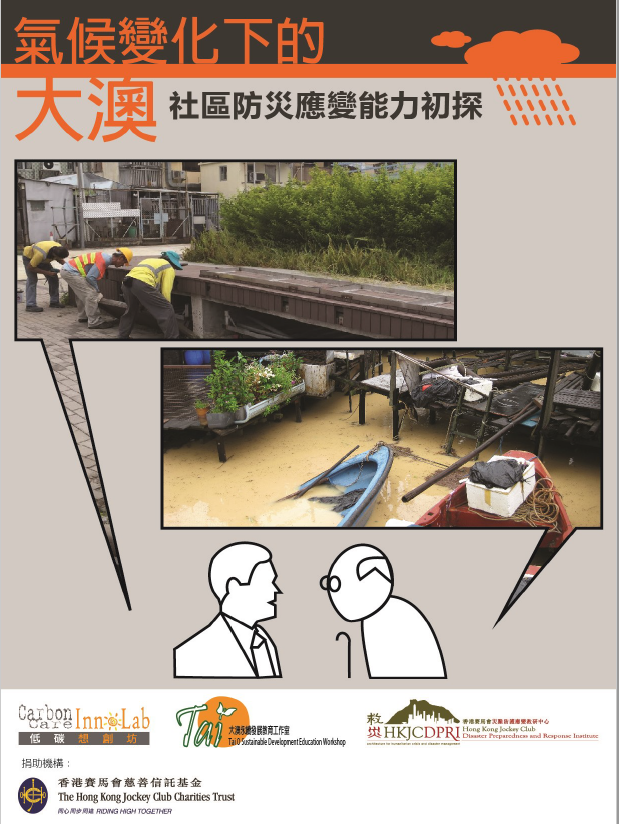
To view the result (Chinese version only):氣候變化下的大澳社區防災應變能力初探
10/08/2016
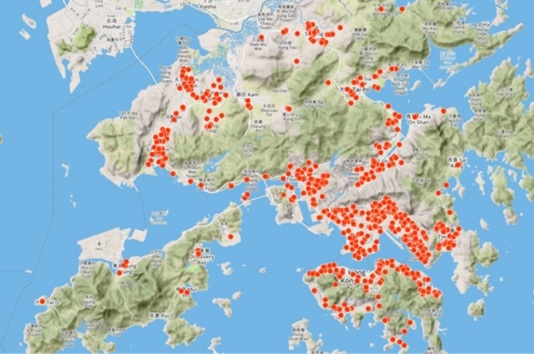
The research titled “Cross-section study on disaster preparedness of Hong Kong citizens using GPS spatial sampling methodology” conducted by University of Hong Kong under the HKJCDPRI Research Grant 2015 programme intended to assess Hong Kong civil society’s perceived and actual preparedness in a variety of disaster scenarios...
The research titled “Cross-section study on disaster preparedness of Hong Kong citizens using GPS spatial sampling methodology” conducted by University of Hong Kong under the HKJCDPRI Research Grant 2015 programme intended to assess Hong Kong civil society’s perceived and actual preparedness in a variety of disaster scenarios...