CALL FOR APPLICATION
About HKJCDPRI Research Grant
The Hong Kong Jockey Club Disaster Preparedness and Response Institute (HKJCDPRI) Research Grant aims to strengthen community disaster resilience by supporting multidisciplinary research. The grant provides financial support to research projects that potentially benefit the development of evidence-based planning, policies and interventions for effective disaster management in Hong Kong.
You are here
出版物 & 研究
出版物 & 研究
我們為研究人員、災難管理人員、醫護人員及學生,提供一個專業交流、合作及政策討論的平台

出版物 & 研究
香港賽馬會災難防護應變教研中心的出版物涵蓋了教研中心跟合作夥伴、顯赫學術機構的研究項目,以及有關災難防護和應變的其他研究與開發。
指引列出了教研中心特別揀選的災難管理技術資訊、操作指引和有用工具。
博客提供了一個平台,讓持份者能分享與災難有關的最新動態、意見及經驗分享。
博客文章由作者以個人身份或代表所屬單位撰寫。內容表達的觀點、思維及意見純屬作者個人想法,並不代表香港賽馬會災難防護應變教研中心的立場。
公眾可在尊重知識產權情況下,使用所有資料,並必須適當引述出處。
2016
10/08/2016
CALL FOR APPLICATION
About HKJCDPRI Research Grant
The Hong Kong Jockey Club Disaster Preparedness and Response Institute (HKJCDPRI) Research Grant aims to strengthen community disaster resilience by supporting multidisciplinary research. The grant provides financial support to research projects that potentially benefit the development of evidence-based planning, policies and interventions for effective disaster management in Hong Kong.
Research Priority of 2016
Priority of Research Grant 2016 would be given to research project(s) that are related to knowledge and information management for disaster preparedness and response in Hong Kong, including disaster risk communication and self-reliance. Research projects related to disaster preparedness and response in Hong Kong are also welcome to apply.
Grant Amount
HKJCDPRI awards grants in varying amounts, depending on the number and type of requests received, the size and scope of the projects for which funding is requested. Grants up to HKD500, 000 are available depending on the scope of the project. All grants are made at the sole discretion of HKJCDPRI.
Eligibility Criteria
Principal investigator of each application should be a full-time staff or with faculty appointment of one of the following domestic organizations:
- Higher education institution
- Not-for-profit organization
- Fellow of Hong Kong Academy of Medicine
- Government department
- Statutory body
Research project should be carried out between October 2016 – September 2017
The research project should not be receiving any supports from other funding or grants.
Application Process
Applications must be submitted with the following documents both electronically (in PDF format) and by post on or before 22 September 2016:
- Application form
- Research proposal
- Curriculum vitae of all investigators
- Other supporting documents (e.g. activity report of applicants’ organization/faculty, if any)
The full application package can be downloaded here.
Please follow the application guidelines for completing your application. Failure to comply with the guidelines may lead to disqualification of the application.
Selection Criteria
Each proposal will be assessed according to its relevance to HKJCDPRI projects, research rigor, management quality of the project and budget, and impact to the society. More information on the selection criteria is provided in the application guidelines.
Important Dates
22 September, 2016 - Deadline of application
Late October, 2016 - Notification of decisions
For more information, please contact us at [email protected] or (852) 2871 8597.
14/05/2016
(The link to the abstract is under "To Know More" on the right)
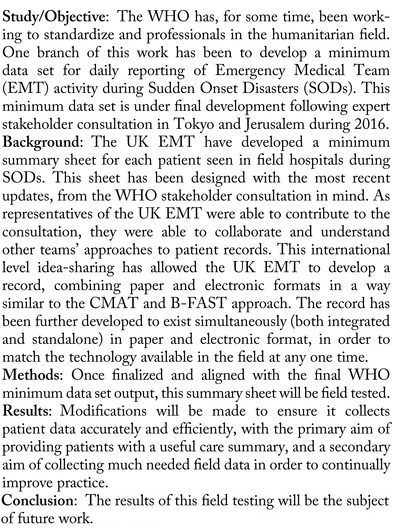
Volume 32, Issue S1 (Abstracts of Scientific Papers-WADEM Congress on Disaster and Emergency Medicine 2017)
Anisa J.N. Jafar1, Chrissy Alcock2, Rachel Fletcher2, Thomas C. Hughes3, Brigid Hayden2, Philip Gaffney4, John Simpson2 and Anthony Redmond1
1 University Of Manchester, HCRI, Manchester/United Kingdom
2 UK Med, Manchester/United Kingdom
3 Emergency Department, John Radcliffe Hospital, Oxford/United Kingdom
4 Xenplate, Cambridge/United Kingdom
(The link to the abstract is under "To Know More" on the right)
Volume 32, Issue S1 (Abstracts of Scientific Papers-WADEM Congress on Disaster and Emergency Medicine 2017)
Anisa J.N. Jafar1, Chrissy Alcock2, Rachel Fletcher2, Thomas C. Hughes3, Brigid Hayden2, Philip Gaffney4, John Simpson2 and Anthony Redmond1
1 University Of Manchester, HCRI, Manchester/United Kingdom
2 UK Med, Manchester/United Kingdom
3 Emergency Department, John Radcliffe Hospital, Oxford/United Kingdom
4 Xenplate, Cambridge/United Kingdom
2015

31/12/2015
(The link to the full article is under "To Know More" on the right)
Prehosp Disaster Med. 2015;30(2):1-7
Anisa J. N. Jafar1, Ian Norton2, Fiona Lecky3 and Anthony D. Redmond1
1 HCRI, Ellen Wilkinson Building, University of Manchester, Manchester, United Kingdom
2 National Critical Care and Trauma Response Center, Darwin, Australia
3 EMRiS Group, ScHARR, Sheffield, United Kingdom
Background
Medical records are a tenet of good medical practice and provide one method of communicating individual follow-up arrangements, informing research data, and documenting medical intervention.
(The link to the full article is under "To Know More" on the right)
Prehosp Disaster Med. 2015;30(2):1-7
Anisa J. N. Jafar1, Ian Norton2, Fiona Lecky3 and Anthony D. Redmond1
1 HCRI, Ellen Wilkinson Building, University of Manchester, Manchester, United Kingdom
2 National Critical Care and Trauma Response Center, Darwin, Australia
3 EMRiS Group, ScHARR, Sheffield, United Kingdom
Background
Medical records are a tenet of good medical practice and provide one method of communicating individual follow-up arrangements, informing research data, and documenting medical intervention.
Methods
The objective of this review was to look at one source (the published literature) of medical records used by foreign medical teams (FMTs) in sudden onset disasters (SODs). The published literature was searched systematically for evidence of what medical records have been used by FMTs in SODs.
Findings
The style and content of medical records kept by FMTs in SODs varied widely according to the published literature. Similarly, there was great variability in practice as to what happens to the record and/or the data from the record following its use during a patient encounter. However, there was a paucity of published work comprehensively detailing the exact content of records used.
Interpretation
Without standardization of the content of medical records kept by FMTs in SODs, it is difficult to ensure robust follow-up arrangements are documented. This may hinder communication between different FMTs and local medical teams (LMTs)/other FMTs who may then need to provide follow-up care for an individual. Furthermore, without a standard method of reporting data, there is an inaccurate picture of the work carried out. Therefore, there is not a solid evidence base for improving the quality of future response to SODs. Further research targeting FMTs and LMTs directly is essential to inform any development of an internationally agreed minimum data set (MDS), for both recording and reporting, in order that FMTs can reach the World Health Organization (WHO) standards for FMT practice.