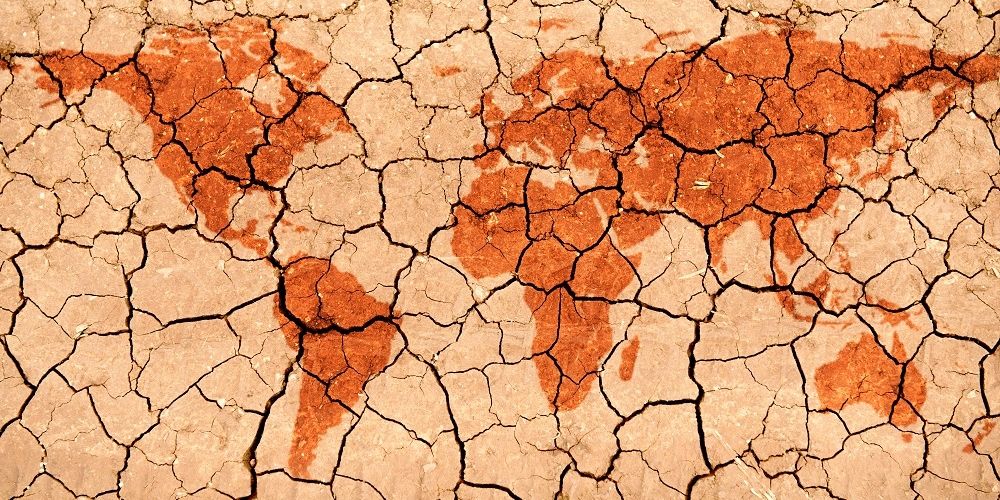
The increasing frequency of natural disasters around the world has been accompanied by concomitant, growing sophistication in disaster planning and response. In recent years, incident command systems, mass casualty trainings, triage protocols, inter-agency communication strategies, along with backup systems for power, personnel, and equipment have all seen an exponential growth in competence and understanding
You are here
出版物 & 研究
出版物 & 研究
我們為研究人員、災難管理人員、醫護人員及學生,提供一個專業交流、合作及政策討論的平台

出版物 & 研究
香港賽馬會災難防護應變教研中心的出版物涵蓋了教研中心跟合作夥伴、顯赫學術機構的研究項目,以及有關災難防護和應變的其他研究與開發。
指引列出了教研中心特別揀選的災難管理技術資訊、操作指引和有用工具。
博客提供了一個平台,讓持份者能分享與災難有關的最新動態、意見及經驗分享。
博客文章由作者以個人身份或代表所屬單位撰寫。內容表達的觀點、思維及意見純屬作者個人想法,並不代表香港賽馬會災難防護應變教研中心的立場。
公眾可在尊重知識產權情況下,使用所有資料,並必須適當引述出處。
2018
09/03/2018
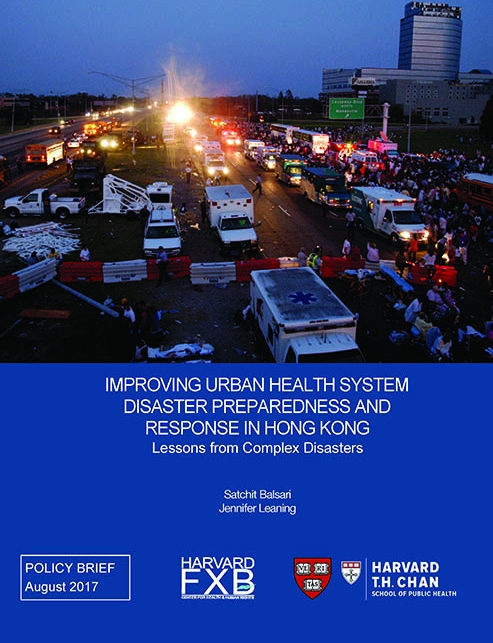
The increasing frequency of natural disasters around the world has been accompanied by concomitant, growing sophistication in disaster planning and response. In recent years, incident command systems, mass casualty trainings, triage protocols, inter-agency communication strategies, along with backup systems for power, personnel, and equipment have all seen an exponential growth in competence and understanding
01/03/2018
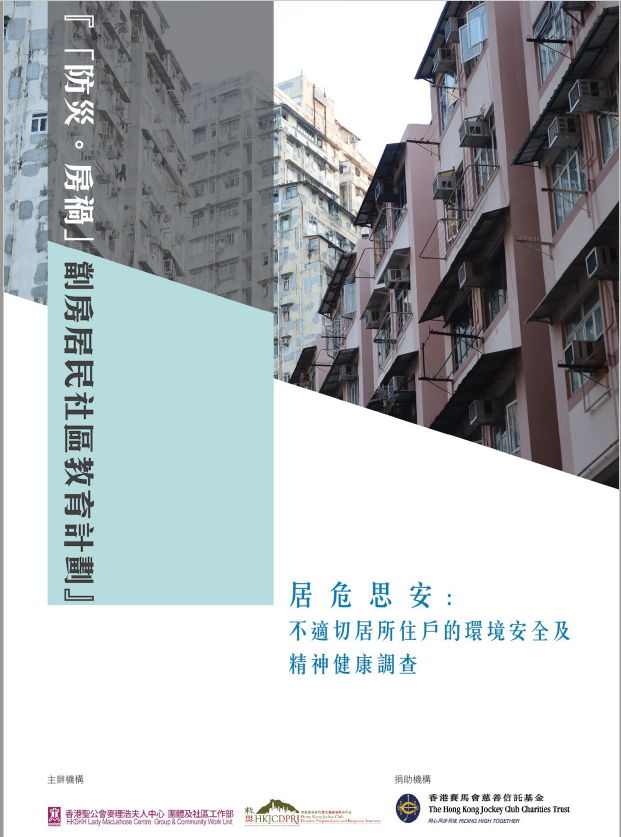
Housing has been a challenge faced by people from all walks of life in Hong Kong. Many have to turn to improper accommodation with poor living environment, including sub-divided flats, cage homes, bedspace apartment, partitioned rooms or rooftop slump.
Regarding inappropriate accommodation, the major concern is its poor living environment, In addition to cramped living space and unsatisfactory indoor air quality, the potential risks induced by building constructions or design must not be overlooked.
Housing has been a challenge faced by people from all walks of life in Hong Kong. Many have to turn to improper accommodation with poor living environment, including sub-divided flats, cage homes, bedspace apartment, partitioned rooms or rooftop slump.
Regarding inappropriate accommodation, the major concern is its poor living environment, In addition to cramped living space and unsatisfactory indoor air quality, the potential risks induced by building constructions or design must not be overlooked.
HKJCDPRI collaborated with the Hong Kong Sheng Kung Hui Lady MacLehose Centre (HKSKHLMC) in 2017 to conduct a survey titled “Community Survey on Physical and Mental risks resulted from Inappropriate Living Environment”, which investigated the impact of four major factors, including fire safety, security, hygiene and risks in indoor environment on residents’ mental health conditions.
The survey was conducted between October and November in the form of purposive sampling. Ten residents living in sub-divided flats in Kwai Tsing district were invited to semi-structured interviews. For a more accurate understanding of the interviewees’ quality of life and mental health conditions, the survey was supplemented by two surveys, namely WHOQOL-BREF (HK) and Depression Anxiety Stress Scale 21 (DASS-21)).
Results showed that the ten respondents living in sub-divided flats are exposed to hidden risks, big and small, in fire safety, security and hygiene. As a result, their physical and mental well-being are constantly at stake. As far as mental health is concerned, seven of them showed symptoms of anxiety, depression and stress; nine experienced mental distress after moving into subdivided flats - two of whom were diagnosed with a mental disorder.
Survey report has suggested that in view of the environmental risks, the government could consider subsidizing residents living in fire-prone areas, the elderly or low-income households to acquire disaster preparedness equipment, such as smoke and gas leakage detectors, fire blankets and dry powder extinguishers. In addition, it could join hands with community organizations to conduct extensive education work on hygiene and fire safety, while launching education plans such as the “Fire Safety Ambassador Scheme” to strengthen residents’ disaster response capacities.
As for mental well-being, the government and community organizations could launch the "District Mental Health Ambassador Scheme” by means of diversified publicity campaigns and education work, so as to promote mental health and provide related resources to residents in improper accommodation. It is hoped that residents can identify their own issues early and build up a community support network to help people help themselves.
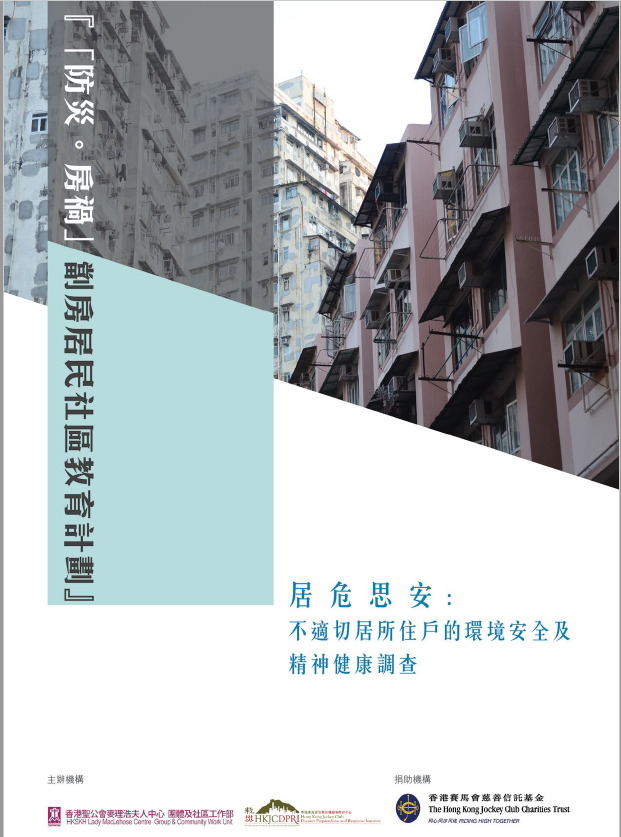
To view the survey result (Chinese version only):居危思安_不適切居所住戶的環境安全及精神健康調查報告.pdf
2017
29/11/2017
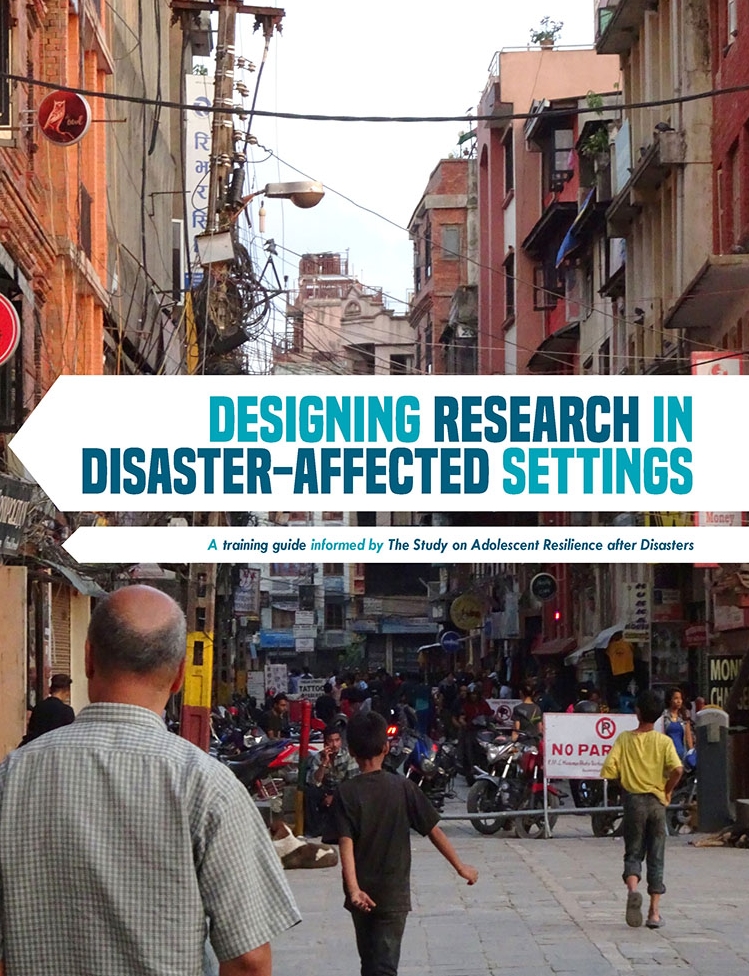
To promote best practices in disaster research and evaluation, the Harvard FXB Center for Health and Human Rights partnered with Curtin University, Kunming Medical University, the Centre for Victims of Torture Nepal and CCOUC to develop a research training guide and accompanying study tools. The resulting manual provides guidance for creating effective research questions, building strong partnerships, and collecting data in emergencies, illustrated with real-life examples.
To promote best practices in disaster research and evaluation, the Harvard FXB Center for Health and Human Rights partnered with Curtin University, Kunming Medical University, the Centre for Victims of Torture Nepal and CCOUC to develop a research training guide and accompanying study tools. The resulting manual provides guidance for creating effective research questions, building strong partnerships, and collecting data in emergencies, illustrated with real-life examples.
19/09/2017
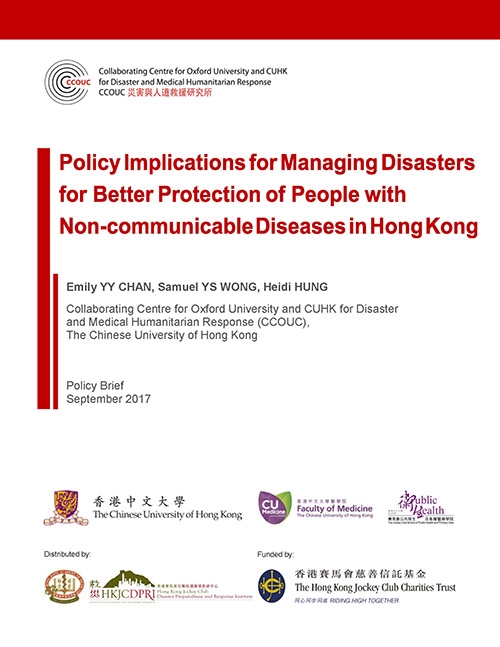
Between 2005 and 2014, disasters have caused total damage of US$1.4 trillion worldwide, with 1.7 billion people affected and 0.7 million killed [1]. With climate change, urbanization, environmental degradation and poverty, the world has been experiencing disasters at a higher frequency and intensity. To be effective, disaster management strategy must be able to meet the health needs of the affected population. With non-communicable diseases (NCDs) now being the major disease burden and leading causes of death worldwide, the traditional health focus of humanitarian response on acute conditions is no longer sufficient to address population health needs in disaster and emergency context. The significance of NCDs management and planning for potential humanitarian context must be recognized.
Between 2005 and 2014, disasters have caused total damage of US$1.4 trillion worldwide, with 1.7 billion people affected and 0.7 million killed [1]. With climate change, urbanization, environmental degradation and poverty, the world has been experiencing disasters at a higher frequency and intensity. To be effective, disaster management strategy must be able to meet the health needs of the affected population. With non-communicable diseases (NCDs) now being the major disease burden and leading causes of death worldwide, the traditional health focus of humanitarian response on acute conditions is no longer sufficient to address population health needs in disaster and emergency context. The significance of NCDs management and planning for potential humanitarian context must be recognized.